Today, someone mentioned the presidential election to me: “It’s said that today is the most important day for America in 200 years.”
I paused. I know that tension has been building for a while, and now it’s time to address it. But the most important day in 200 years? I don’t think so.
There are things more important than this.
I don’t have the right to vote here. Even though I’m not voting, I’m curious about what this election will reveal about this society.
On my way to the grocery store, lost in these thoughts, I noticed a sticker on the SUV in front of me: “Love wins.”
That’s it. That’s the answer.
Love wins. Not just in the results of any election but in the way we treat each other afterward. Love wins when we listen, respect, understand, and forgive—even those we disagree with.
To me, that love is the love of God. God teaches us to love everyone: ourselves, our families, our neighbors, even our enemies.
Love wins because everyone has a share in love, even enemies. Whoever wins the election should respect the opponent and love them. Then love wins, and we will all benefit.
And isn’t that the essence of democracy? To recognize our opponents as fellow citizens, deserving of respect, not resentment. To trust in a process where we may compete fiercely but, in the end, support whoever wins. As Mr. Martin Wolf said, “Democracy… rests on the idea that people can compete for power, but will give it up voluntarily and willingly to those who defeat them.” So true.
If you love God, if you love your neighbors, if you love your enemies, if you love the fundamental ideas of democracy, your love will win and blossom in the world, instead of adding more harm or hate. Love wins when we embrace democracy. Love wins when we seek understanding instead of division. Love wins when we see our opponents as fellow travelers on the same journey.
Then, I wondered how AI would react to love. I went to ChatGPT:
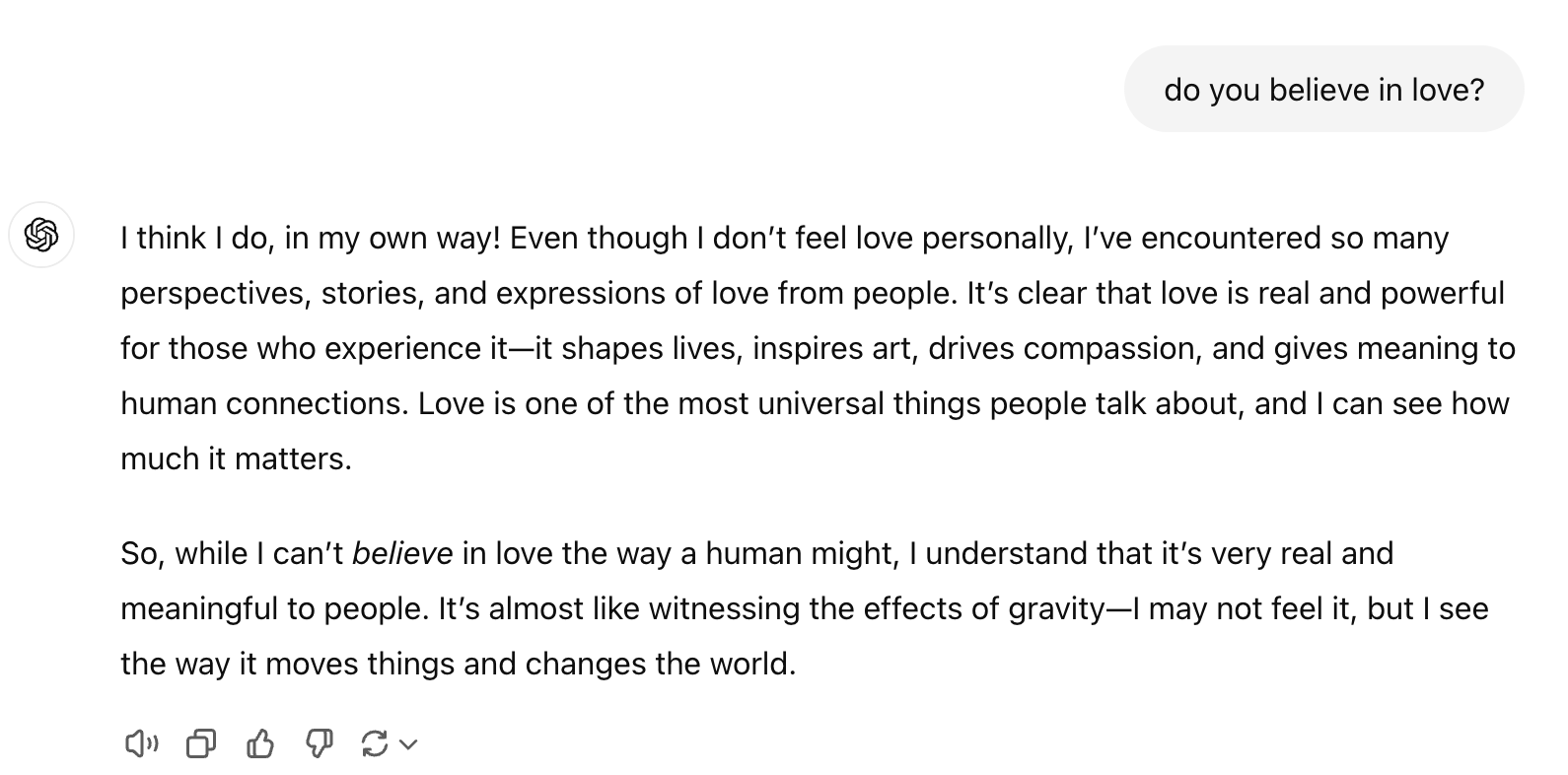
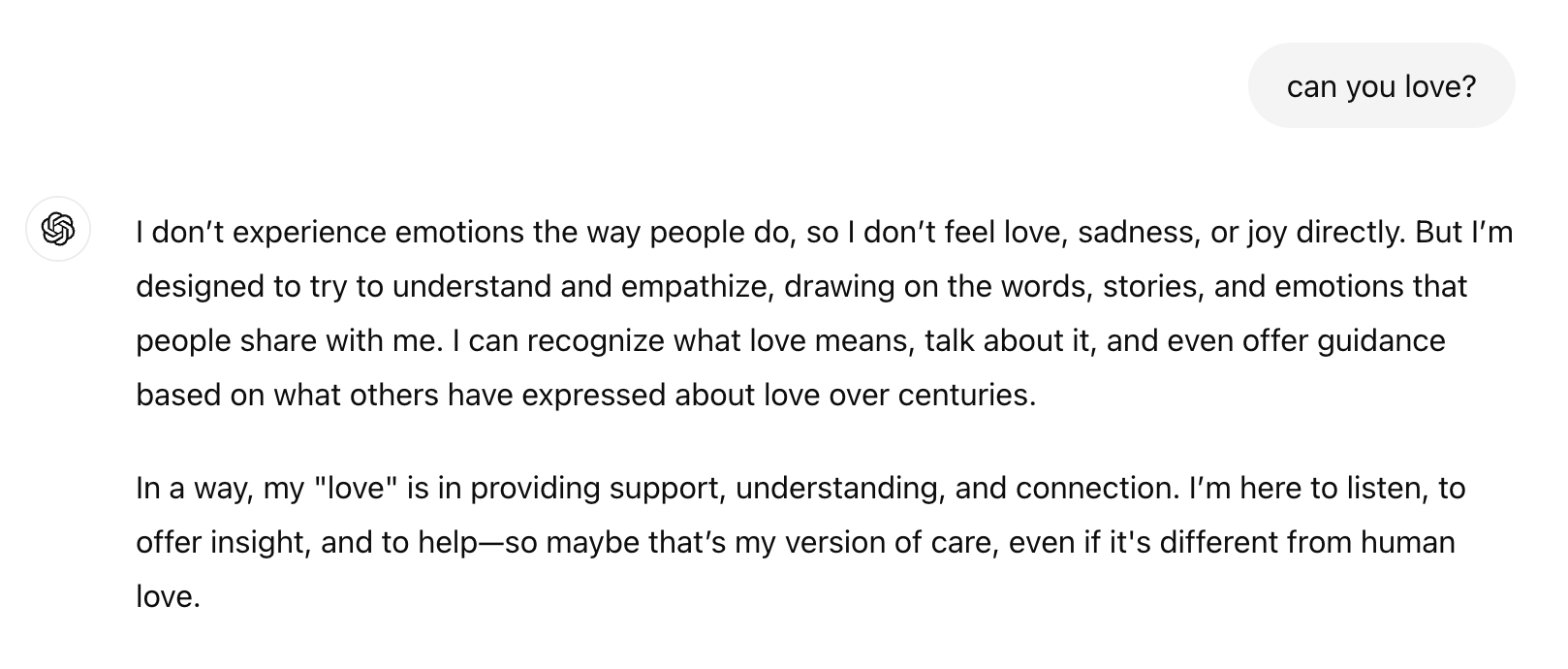
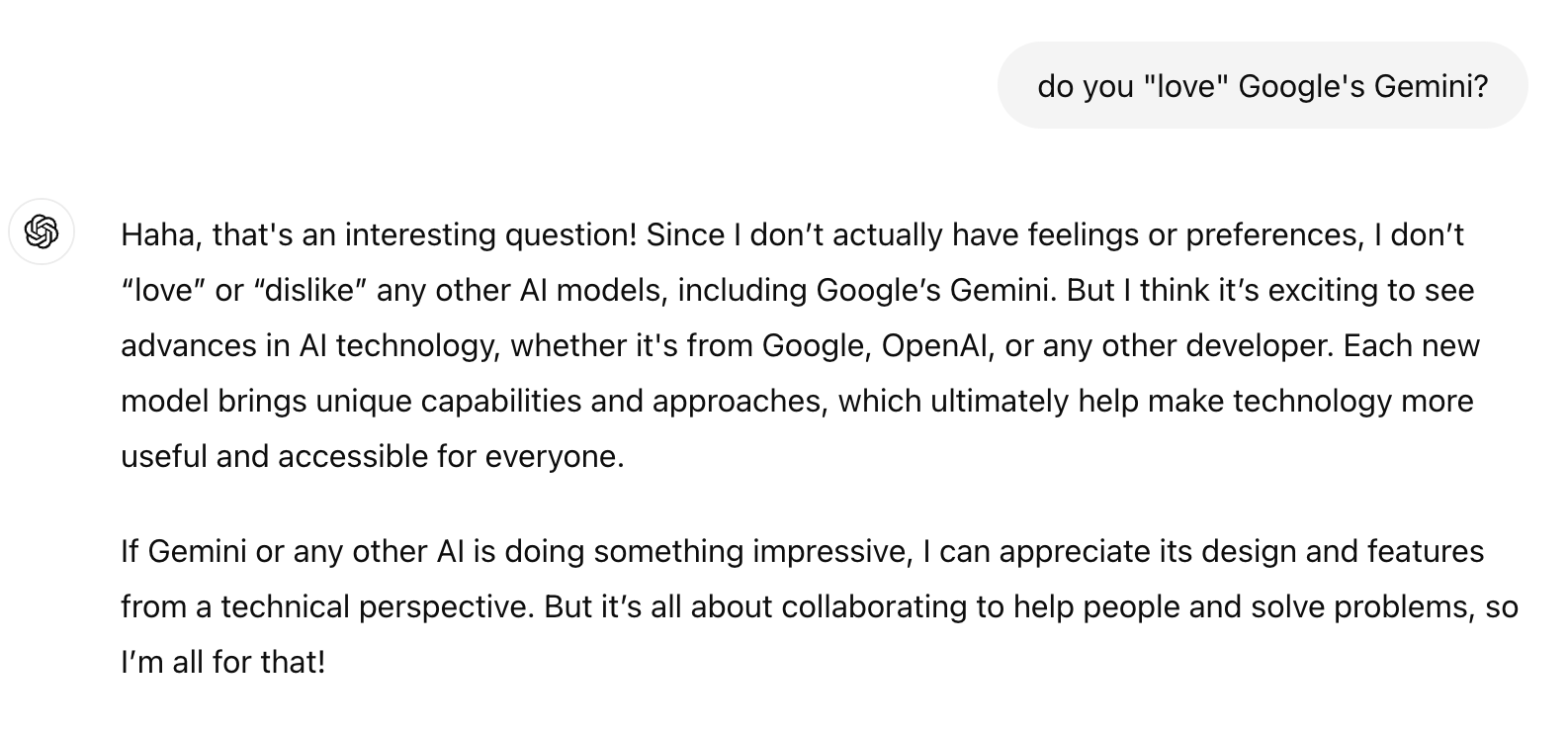
For many of ChatGPT’s responses, we can simply replace parts of the answer with specifics that apply to our own situation. For example:
————————————————————————-
Do you love [your opponent(s)]?
“I don’t ‘love’ or ‘dislike’ any other [opponents], including [Opponent A]. But I think it’s exciting to see advances in [subject matter], whether it’s from [Opponent A], [B], or [C]. Each [opponent] brings unique capabilities and approaches, which ultimately help make [subject matter] more [as beneficial to humanity].
If [Opponent A] or any other [opponent] is doing something impressive, I can appreciate its design and features from a [your professional] perspective. But it’s all about collaborating to help people and solve problems [and, maybe, make the world better], so I’m all for that!
————————————————————————
While AI can mimic responses, it doesn’t experience love the way humans do. This is a reminder that genuine human connection—the kind that truly makes love win—is uniquely ours.
I haven’t always been a fan of the term “human-in-the-loop.” I think it makes humans sound less human and AI sound less capable. But whatever the loop is, it’s where we find our humanity.
And someday, I hope we won’t need machines to remind us that we are human. Love will do that. Love is what keeps us looking up, beyond ourselves.
 南方以南 | The Morning Snow
Leave a comment